What Legal Remedies Are Available If Police Refuse to Register an FIR?
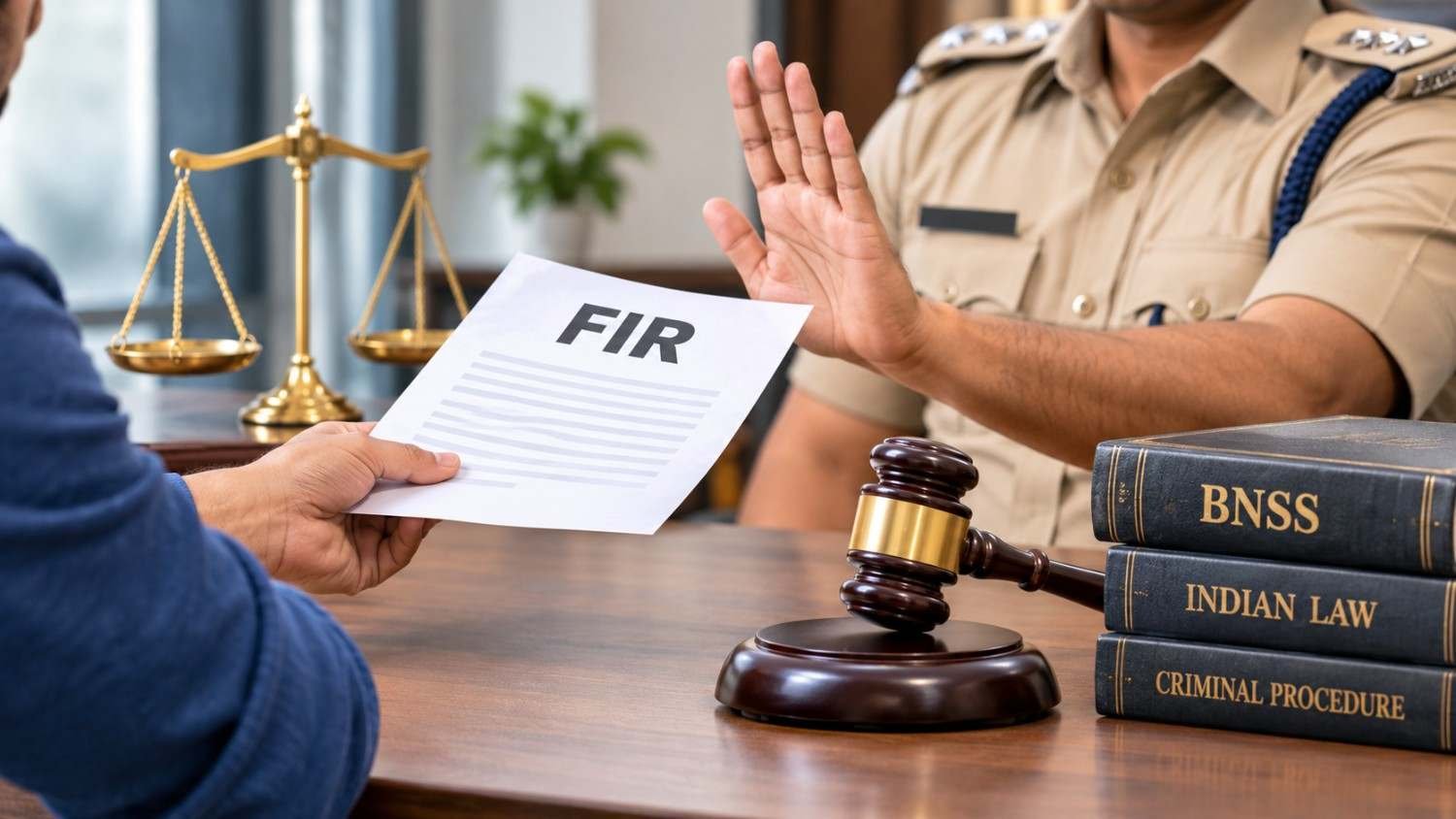
Imagine approaching a police station to report a serious offence, only to find that the police refuse to register your complaint. Such situations can leave victims confused about their legal rights and the steps they should take next. However, Indian law provides specific remedies when police authorities fail to record information about a cognizable offence.
Under the Bharatiya Nagarik Suraksha Sanhita (BNSS), 2023, individuals have the right to approach senior police officers and seek judicial intervention if their request for FIR registration is ignored. Understanding these legal provisions can help individuals protect their rights and take appropriate action. Global Judex Law Firm explains the available legal remedies, relevant provisions and practical steps to follow when police refuse to register an FIR.
When Is Police Registration of an FIR Mandatory?
An FIR, or First Information Report, is the formal record of information received by police regarding the commission of a cognizable offence. It sets the criminal investigation process in motion.
Under Section 173(1) of the BNSS, information relating to a cognizable offence can be provided orally or through electronic communication, irrespective of where the offence occurred.
When the information discloses a cognizable offence, the police are generally required to register an FIR. They cannot refuse registration merely because they doubt the complainant’s credibility or believe that further investigation is necessary.
However, Section 173(3) permits a preliminary inquiry, with prior permission from an officer not below the rank of Deputy Superintendent of Police, in certain cognizable offences punishable with imprisonment of three years or more but less than seven years. Such an inquiry must be completed within fourteen days.
The Supreme Court also recognised the principle of mandatory FIR registration in Lalita Kumari v. Government of Uttar Pradesh (2013).
Legal Remedies Available If Police Refuse to Register an FIR
If the police refuse to record information about a cognizable offence, an individual can explore the following legal remedies.
1. Submit a Written Complaint to the Superintendent of Police
The first statutory remedy is provided under Section 173(4) of the BNSS.
If the officer in charge of a police station refuses to register an FIR, the aggrieved person can send the substance of the complaint in writing and by post to the concerned Superintendent of Police (SP).
The complaint should contain:
- Details of the incident and the alleged offence.
- Date, time and location of the occurrence.
- Names of the accused, if known.
- Available evidence and supporting documents.
- Details of the police station where FIR registration was refused.
- A request for appropriate action and investigation.
If the SP is satisfied that the information discloses a cognizable offence, they must either investigate the matter themselves or direct a subordinate police officer to conduct the investigation.
Global Judex Law Firm advises complainants to retain copies of their complaints, postal receipts and delivery records as proof of communication.
2. Approach the Magistrate Under Section 175(3) BNSS
If the Superintendent of Police does not take appropriate action, the complainant can approach the jurisdictional Magistrate under Section 175(3) of the BNSS.
The Magistrate has the authority to consider an application seeking an order for police investigation.
The application should generally include:
- A copy of the original police complaint.
- Proof of submission to the police station.
- A copy of the complaint sent to the SP.
- Supporting documents and available evidence.
- An affidavit supporting the application.
After considering the application, making any inquiry deemed necessary and examining the submissions of the police officer, the Magistrate may order an investigation.
This provision provides an important judicial remedy when police authorities fail to perform their legal responsibilities.
3. File a Private Complaint Before the Magistrate
Another option is to file a private complaint before the competent Magistrate under the relevant provisions of the BNSS.
Under Section 210, a Magistrate may take cognizance of an offence upon receiving a complaint of facts constituting an offence, subject to the applicable legal requirements.
The Magistrate may examine the complainant and witnesses under Section 223 and decide the appropriate course of action.
Depending on the circumstances, the court may proceed with the complaint, conduct further inquiry or take other steps permitted by law.
Global Judex Law Firm can help individuals understand the difference between seeking a police investigation and pursuing a complaint case before the court.
4. Approach the High Court in Appropriate Cases
In certain exceptional circumstances, an individual may approach the High Court under Article 226 of the Constitution of India.
The High Court has the power to issue appropriate writs and directions to protect legal and fundamental rights.
However, approaching the High Court is not automatically the first remedy whenever police refuse to register an FIR. Courts generally expect individuals to use the statutory remedies available under Sections 173(4) and 175(3) BNSS, unless exceptional circumstances justify direct intervention.
A person seeking such relief should obtain appropriate legal advice before initiating proceedings.
What Should You Do If Police Refuse to Register Your Complaint?
Taking timely and organised steps can make your legal case stronger. Consider the following actions:
- Prepare a detailed complaint: Clearly explain the incident and identify the alleged cognizable offence.
- Collect supporting evidence: Preserve photographs, videos, messages, medical records and relevant documents.
- Keep written records: Maintain copies of complaints and acknowledgements.
- Escalate the matter: Send a written complaint to the Superintendent of Police under Section 173(4) BNSS.
- Seek judicial assistance: Approach the jurisdictional Magistrate under Section 175(3) if the statutory escalation does not resolve the issue.
- Consult a legal professional: Obtain guidance on the correct procedure and available remedies.
If the matter involves complex criminal proceedings, guidance from a Best Advocate in Supreme Court or a Best Advocate in Delhi High Court can help in understanding the appropriate judicial remedies.
How Can a Lawyer Help in Cases of FIR Refusal?
Legal proceedings involving police inaction require a clear understanding of criminal procedure, statutory provisions and judicial remedies.
An experienced criminal lawyer can assist with drafting complaints, preparing supporting documents, filing applications before the Magistrate and representing the complainant during court proceedings.
For matters involving business fraud, financial misconduct or commercial disputes, consulting a Company lawyer in Delhi may also help identify the appropriate legal course.
Global Judex Law Firm assists clients with criminal litigation and legal proceedings through a structured approach based on the facts of each matter. The firm focuses on identifying applicable legal provisions and helping clients understand their available remedies.
Conclusion
Refusal by police to register an FIR does not mean that an individual has lost the right to seek justice. The BNSS provides a legal framework through which complainants can approach senior police authorities and the judiciary to address police inaction.
Understanding these remedies and following the correct legal procedure is essential to protecting your rights. Global Judex Law Firm encourages individuals facing such situations to seek appropriate legal guidance and take informed steps rather than allowing their complaints to remain unaddressed.