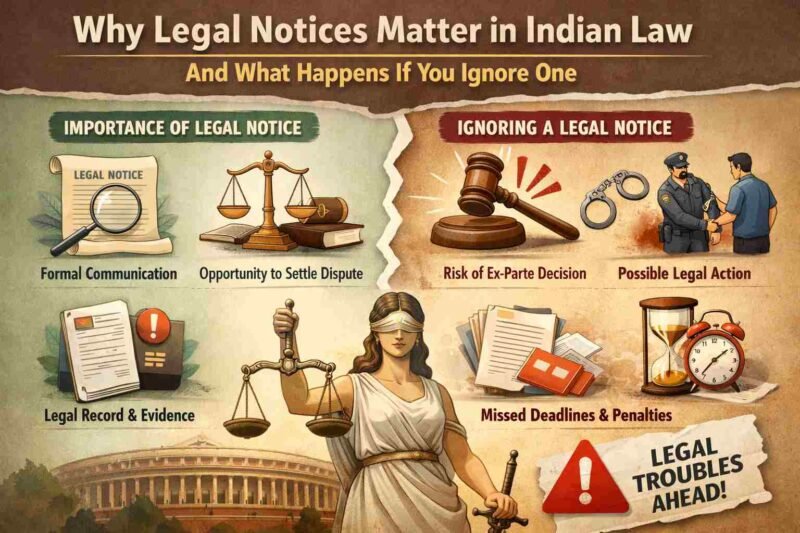
Why Legal Notices Matter in Indian Law and What Happens If You Ignore One
Global Judex Law Firm Team2026-05-19T11:35:16+00:00Civil lawsuits seldom begin within a courtroom. They normally start with a legal notice. imagine it to be a kind of warning–stated politely but with seriousness. The first thing that many people would encounter with a cheque bounce lawyer in Delhi would be after getting the notice like this, the usual question, can I ignore this?
Brief response: You may not care, but you might not want to. Indian law considers a legal notice as a serious pre-litigation measure. It provides an equal opportunity to the parties to settle the case without having to spend years in Court or pay expensive legal expenses.
This guide also describes the meaning of legal notice, why it is important in Indian law, and what really happens when one does not follow it. The facts below are based on actual legal provisions, common sense, and reliable government sources- not on presumptions or hyperbole.
What Is Legal Notice in Simple Terms?
A legal notice by advocate is a written communication between one party to another, which is sent through a formal communication in order to notify the other party about a legal problem or complaint. It asks the action, payment or compliance within a defined time.
To defend the rights of their client, lawyers provide an advocate notice to establish a proper legal history. This communication is usually perceived by courts as an indication that the sender tried to solve the conflict prior to initiating a lawsuit.
A legal notice in plain language is the legal system equivalent to saying:
Before we go to court, we should correct this issue.
Common Situations Where Legal Notices Are Used
Lawful notices are found in various daily controversies, including:
- Cancellation of lost money, loans.
- Cheque bounce cases
- Landlord-tenant conflicts or property.
- Employment termination issues
- Consumer complaints
- Divorce issues with a divorce lawyer in Delhi high court.
Even in most of such cases, the law itself demands the issue of issuing a legal notice prior to case filing.
Why Legal Notices Matter in Indian Law
Legal notices are important in ensuring equity and transparency in the legal system. Global Judex Law Firm assists people and companies in resolving conflicts in a formal manner but providing both parties with a chance to settle the conflict outside of the court.
Indian courts are very much promoting pre-trial settlement. This is a cost-saving measure that saves time, minimizes costs and burdens the judicial system.
The National Judicial Data Grid (NJDG) stated that Indian courts are yet to dispose of millions of cases. Legal notices can be used to resolve disputes early, which can be used to reduce this backlog and help in delivering justice faster.
1. They Provide a Chance to Resolve Disputes Early
A court notice brings about negotiation. It alerts the recipient regarding the problem and enables them to react before the situation becomes out of control.
As an illustration, in a legal notice for recovery of money, the debtor may be willing to repay the debt after being aware of legal implications of not repaying the debt. This move can save the court a protracted litigation.
Relationships are also safeguarded by early resolution. Tensions among business partners, employers, tenants and family members can be resolved without causing harm to long-term trust.
2. They Fulfill Legal Requirements Under Indian Law
In India, there are some laws that require legal notices. The court can dismiss the case, even in case of a valid claim, without issuing the necessary notice.
Some of the important legal provisions are as follows:
Article 80 of the code of civil procedure 1908
This part makes people provide a legal notice prior to initiating a case against the government or a governmental authority. The law also requires a waiting period of two months after sending the notice.
Section 138 of the Negotiable Instruments Act, 1881
This is applicable in cases of cheque bounces. Within 30 days of receiving a return memo by the bank the payee has to send a legal notice.
This may lead to postponement of justice and high legal expenses due to lack of following these requirements. This is the reason why a lot of individuals seek the services of a cheque bounce lawyer in Delhi as soon as they are issued with a cheque dishonor.
3. They Create Strong Documentary Evidence
Any legal case is based on evidence. A legal notice is a written evidence that there was a communication between the parties.
Documented communication is important to courts as it demands clarity and leads to less confusion. An adequate notice will create:
- The date on which the dispute took place.
- The character of the assertion.
- The request of the sender.
- The chance provided to solve the problem.
In case the recipient disregards the notice, the sender will be able to use it as an evidence of being responsible. This is a factor that judges look at in most cases when deciding the case.
Also Read : Corporate Legal Services in Delhi: NCLT, Arbitration & Company Law Explained
What Should a Proper Legal Notice Format Include?
A legal notice format is structured to maintain clarity, professionalism and legal accuracy. Ill-crafted notices may cause miscommunication or dilute a legal argument.
A good legal notice contains the following points:
- Address and full name of the two parties.
- Specification of conflict.
- Citation of pertinent provisions of law.
- Obvious demand or request.
- Deadline for response
- Consequences of non-compliance
- Contact and signature information of the advocate.
An effective legal notice is written in the form of a professional dialogue. It is factual, not emotional and presents the legal stance in an understandable manner.
Real Situations Where Legal Notices Play a Key Role
Litigation notices are found in personal and business litigation. Global Judex Law Firm are significant in more than significant legal disputes. There are a lot of everyday conflicts that need written communication prior to commencing legal proceedings.
Knowledge of these cases assists people to identify instances when a notice needs to be sent or responded to.
Also Read : What Is FIR? Full Form, Definition, and Delhi Online FIR Process
Cheque Bounce Cases
One of the most prevalent causes of dispatching legal notices in India is that of cheque bounces. A cheque bounces because of insufficient funds or closure of the account and the banks send a return memo.
Once this memo has been received, the payee is expected to make a legal notice within the time which is prescribed in law. This is a notice that requires payment and satisfies the statutory requirements.
A cheque bounce lawyer in Delhi is consulted by many immediately after a cheque bounce since failure to meet deadlines may undermine the case.
The timely response enhances prospects of recovery and legal position.
Family and Divorce Matters
There are emotional and monetary issues that are common to family disputes. Legal notices are a formal means of communicating demands that do not threaten the intensification of conflict.
A divorce lawyer in Delhi high court can send a legal notice on:
- Maintenance or alimony
- Child custody arrangements
- Property division
- Separation terms
This is done to enable both parties to know their rights and responsibilities prior to stepping into a courtroom.
Business and Payment Disputes
Legal notices are commonly used by businesses to collect their outstanding invoices or to deal with contract breaches. These conflicts are associated with career and financial risk.
As an example, a firm can issue a court letter to recover money when a customer does not pay the pending bills. This is to inform that settlement is being encouraged but the right to pursue a case should it be necessary is maintained.
In business, litigation can be costly and time-consuming which can be avoid by timely communication.
What Happens If You Ignore a Legal Notice?
Disregard of a legal notice will hardly resolve the issue. Rather, it tends to cause more legal and financial risks.
Now, we will discuss the actual implications.
1. The Sender Can bring a case to court.
In the event of non-response by the recipient within the stipulated time, the sender is able to file a lawsuit.
Court cases involve:
- Legal fees
- Court appearances
- Documentation expenses
- Time delays
Even basic conflicts may require months or years to settle. These complications are usually avoided by responding to the notice early.
2. Silence can be regarded as negligence by the Court.
Both parties are expected to behave responsibly in courts. Overlooking a notice is an indication of lack of cooperation.
Silence may be construed by judges to mean:
- Carelessness
- Irresponsibility towards the law.
- Lack of good faith
This perception may render the recipient weaker in his/ her defense and may influence the final case result.
3. Financial Liability can be on the rise
Failure to respond to a legal notice may lead to more financial liability. Courts could impose extra compensation, interest or legal expenses on the other party.
Examples include: in cases with cheques bouncing, the court may sentence:
- Up to three times the amount of the cheque.
- Legal expenses
- Potential incarceration as provided in Section 138 of the Negotiable Instruments Act.
These risks are minimized by early response.
What to do in Response to a Legal Notice?
Answering a notice of law does not imply an acceptance of guilt. It just demonstrates the sense of responsibility and understanding of the law.
These are some of the steps to be taken practically.
Step 1: Calm down and Read the Notice
A lot of individuals panic upon getting a legal notice. This is a natural response but panic is a bad way to make decisions.
Read the notice attentively. Get familiar with the claims, deadlines, and references to the law and then act.
Step 2: Seek the Advice of a competent lawyer.
The advice of the law averts expensive errors. An experienced lawyer will be able to analyze the notification and suggest the most appropriate course of action.
In case you need to check in on professional services, you may visit the Google My Business profile site of Global Judex Law Firm to see the office information, credentials, and reviews.
Step 3: Reply in a Timely and Professional manner
Written response safeguards your legal stand. It states your part of the case, and shows readiness to settle the dispute.
Courts appreciate prompt and responsible communication.
Common Mistakes People Make with Legal Notices
Even senior people are prone to making mistakes that can be avoided when handling legal notices.
The following are the most common
Ignoring the Notice
It is still the most common error. Silence would seldom solve any legal issues.
Responding Emotionally
Defensive or angry responses may cause further legal issues. The communication between professionals is always effective.
Missing Deadlines
Delays undermine credibility and diminish bargaining strength.
Using Incorrect Information
The notice can be invalidated or legal proceedings postponed by wrong addresses, dates or facts.
Practical Tips to Handle Legal Notices Safely
It is important to plan and pay attention to detail when dealing with a legal notice.
Easy tips to follow:
- Copy all the documents.
- Keep a good record of communication.
- Answer on time.
- Early seek professional legal advice.
- Do not give oral promises that are not written.
These practices guard your legal rights and also trim excessive stresses.
Final Thoughts: Treat Legal Notices Seriously but Stay Calm
A legal notice is not a penalty. It is an official means of communication that aims at settling conflicts effectively and justly.
A prudent reaction safeguards your reputation, money, and legal privileges. It should not be disregarded as it can cause unneeded complications.
Indian law encourages out of court communication prior to court proceedings as early communication saves time, minimizes expenses, and promotes justice.
If you receive a legal notice, stay calm, seek professional advice, and respond promptly. A thoughtful response today can prevent a long legal battle tomorrow.
Frequently Asked Questions (FAQs) About Legal Notice in India
A legal notice is a formal written communication that informs someone about a legal dispute or demand. It usually acts as the first step before filing a court case.
Yes, certain laws require a legal notice before filing a case, such as government disputes and cheque bounce matters. In other situations, sending a notice is recommended but not always compulsory.
Ignoring a legal notice can lead to legal action, including a court case and additional financial liability. Courts may also view silence as negligence or lack of cooperation.
Most legal notices provide 7 to 30 days to respond, depending on the nature of the dispute.
In cheque bounce cases, the recipient usually gets 15 days to make payment.
Yes, you can send a legal notice without a lawyer if you understand the legal requirements. However, many people prefer a legal notice by advocate to avoid mistakes and ensure accuracy.