
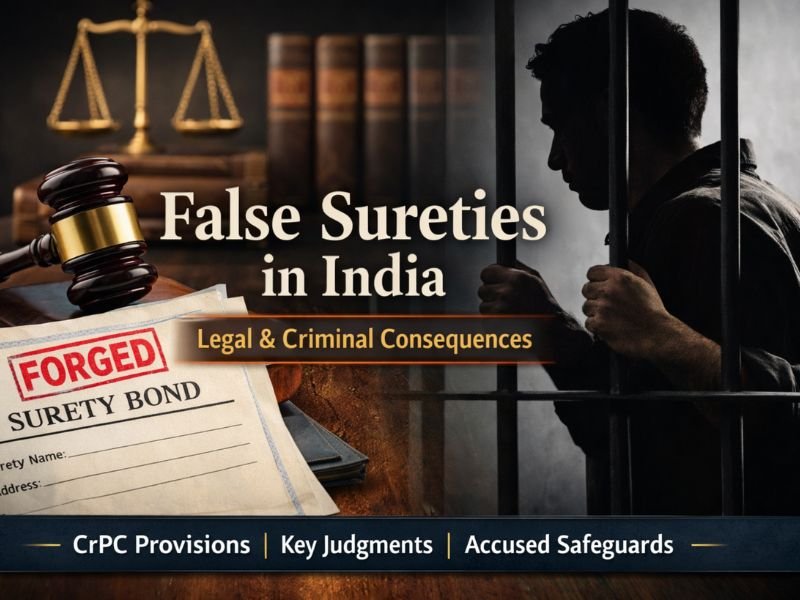
LEGAL CONSEQUENCES AND CRIMINAL LIABILITY ARISING FROM FALSE SURETIES IN INDIA
ABSTRACT
The system of bail occupies a pivotal position in India’s criminal justice framework, balancing the constitutional presumption of innocence with the need to ensure the presence of the accused during trial. A crucial component of this system is the furnishing of sureties. However, the growing menace of false, forged, or impersonated sureties has seriously undermined the administration of justice. This article examines the legal consequences and criminal liability arising from false sureties, analysing statutory provisions under the Code of Criminal Procedure and the Indian Penal Code/Bharatiya Nyaya Sanhita, along with important judicial pronouncements such as Ram Lal v. State of U.P. and Sumit Kumar v. State of Haryana. The article argues for a nuanced approach that distinguishes between culpable sureties and innocent accused persons, while emphasising the need for systemic reforms.
1. INTRODUCTION
Bail is not a privilege but a legal and constitutional safeguard flowing from Article 21 of the Constitution of India. The requirement of furnishing sureties is intended to secure the appearance of the accused before the court and ensure compliance with bail conditions. Over time, however, the bail system has been distorted by the emergence of professional and fictitious sureties, forged documents, and impersonation.
False sureties not only defeat the purpose of bail but also clog the criminal justice system with collateral litigation, leading to delays and miscarriage of justice. Courts are increasingly confronted with cases where forged identity proofs, fake property documents, or impersonators are presented as sureties, raising complex questions regarding the liability of the surety, consequences for the accused, and the role of the court in preventing such abuse.
2. CONCEPT OF SURETY AND ITS LEGAL BASIS
Under the Code of Criminal Procedure, 1973 (CrPC), a surety undertakes a legal obligation to ensure that the accused complies with the conditions of bail. The surety bond is a contractual and statutory undertaking between the surety and the court.
Key provisions include:
Section 441 CrPC – Bond of accused and sureties
Section 446 CrPC – Procedure when bond is forfeited
Section 446A CrPC – Cancellation of bond and consequences
A surety must be competent, identifiable, and capable of fulfilling the bond amount. Furnishing false information or forged documents strikes at the root of this statutory scheme.
3. MEANING AND FORMS OF FALSE SURETY
A false surety may arise in several forms, including:
- Impersonation of another person as surety
- Use of forged or fabricated identity documents
- Submission of false property ownership records
- Professional sureties repeatedly stand as a guarantee without a genuine connection.
- Misrepresentation of financial capacity
Such acts involve deception and intentional misuse of the judicial process.
4. LEGAL CONSEQUENCES OF FURNISHING FALSE SURETY
4.1 Forfeiture of Bond
Under Section 446 CrPC, if the court is satisfied that the bond has been forfeited, it may:
- Record grounds of proof
- Impose a penalty on the surety
- Recover the amount as arrears of land revenue
This consequence flows irrespective of criminal prosecution.
4.2 Independent Liability of Surety: Ram Lal v. State of U.P.
In Ram Lal v. State of U.P. (1979), the Supreme Court held that:
- A surety’s obligation is independent and enforceable
- Failure to take a personal bond from the accused does not invalidate the surety bond
- Once a surety executes the bond, liability attaches irrespective of procedural lapses.
This judgment firmly establishes that a surety cannot escape liability by pointing to defects in the bail process, thereby reinforcing accountability.
5. CRIMINAL LIABILITY ARISING FROM FALSE SURETIES
False surety cases often attract substantive criminal offences.
5.1 Penal Provisions Involved
Depending on facts, the following provisions may apply:
- Cheating and impersonation
- IPC Sections 419, 420
- BNS Sections 319, 318
- Forgery and use of forged documents
- IPC Sections 467, 468, 471
- BNS Sections 336, 338, 340
- Criminal conspiracy
- IPC Section 120B / BNS equivalent
The essential requirement is mens rea, i.e., knowledge or intention to deceive.
6. LIABILITY OF THE ACCUSED: A CRITICAL DISTINCTION
A crucial legal question is whether the accused should suffer criminal consequences merely because a false surety was furnished on their behalf.
6.1 Judicial Clarification: Sumit Kumar v. State of Haryana
In Sumit Kumar v. State of Haryana, the Punjab & Haryana High Court drew a vital distinction:
- Mere benefit derived by the accused does not establish criminal liability.
- Unless there is evidence of knowledge, consent, or active participation, the accused cannot be prosecuted for forgery committed by the surety.
- Imposing rigid bail conditions, such as mandatory local sureties, can result in de facto denial of bail.
The Court emphasised that criminal liability is personal and cannot be presumed, especially when the accused is already in custody and dependent on others for arranging sureties.
7. EFFECT OF FALSE SURETY ON BAIL STATUS OF ACCUSED
While criminal liability may not automatically arise, courts may:
- Cancel bail under Section 446A CrPC
- Direct furnishing of fresh sureties
- Impose alternative conditions, such as personal bonds or verification mechanisms
However, courts must ensure that cancellation of bail is not punitive but corrective.
8. SYSTEMIC CHALLENGES AND JUDICIAL RESPONSE
The prevalence of false sureties highlights systemic failures, including:
- Over-reliance on local sureties
- Inadequate verification mechanisms
- Emergence of professional surety networks
Courts have increasingly advocated:
- Use of Aadhaar-based verification
- Digital record-keeping
- Relaxation of rigid surety conditions for out-of-state accused
- Preference for personal bonds in suitable cases
9. SUGGESTIONS AND REFORMS
To curb the menace of false sureties:
- Courts should prefer personal bonds for minor and first-time offences
- Uniform verification protocols should be implemented
- The liability of the accused should be confined to cases involving clear mens rea.
- Professional surety rackets must be strictly prosecuted.
- Judicial officers must be sensitised to the
constitutional implications of onerous bail conditions
10. CONCLUSION
False sureties pose a serious threat to the integrity of the bail system and the administration of justice. While the law rightly imposes stringent consequences on culpable sureties, courts must guard against unjustly penalising accused persons who lack knowledge or involvement in such frauds. The jurisprudence emerging from Ram Lal and Sumit Kumar reflects a balanced judicial approach—one that enforces accountability without sacrificing constitutional liberty.
A fair, efficient, and humane bail system requires not only strict enforcement against fraud but also systemic reform to prevent its recurrence.