
Legal Separation vs Divorce in India: Key Differences Explained
The experience of marriage functions as a lengthy road journey. The journey maintains its smooth operation during specific times. The passengers need to reach different destinations at particular times. The situation leads couples to start looking for information about legal separation vs divorce. Their goal is to achieve understanding and relaxation while finding protection for their upcoming situations.
People who currently consult a divorce lawyer at Saket Court have probably encountered judicial separation or family court separation terms. First impressions of these two legal options show them as identical options because of their shared features. The process of understanding the two options enables people to achieve savings in various aspects of their life.
The guide provides actual information about Indian legal system based facts. The information contains no myths and no courtroom scenes which exist in movies. The article presents reliable practical information which you can believe.
What Is Legal Separation in India?
Let us start with the basics. Many people ask, what is legal separation?
Indian law employs the term judicial separation instead of using the term legal separation. The Hindu Marriage Act of 1955 and the Special Marriage Act of 1954 provide courts with authority to permit married couples to separate their living arrangements while still maintaining their marital status.
Judicial Separation Meaning in Simple Words
The judicial separation meaning is straightforward:
You remain legally married, but the court allows you to live apart and stop marital obligations like cohabitation.
Think of it as pressing the “pause” button instead of the “stop” button.
A matrimonial lawyer in Saket Court often recommends this option when couples need space to reflect before making a permanent decision.
Also Read : Why Legal Advisory Is Essential for Companies and Corporations in Delhi
What Is Divorce in India?
Divorce ends the marriage legally and permanently. The court grants a divorce decree which makes both spouses single again. The divorced partners can remarry while managing their finances on their own and they can move forward without any legal connection to their former marriage.
Indian courts grant divorce under laws such as:
- Hindu Marriage Act, 1955
- Special Marriage Act, 1954
- Indian Divorce Act, 1869
Common grounds for divorce include:
- Cruelty
- Desertion
- Adultery
- Mutual consent
- Irretrievable breakdown of marriage (recognized through court interpretation)
A skilled divorce lawyer in Saket Court can guide couples through documentation, mediation, and court hearings to ensure the process stays smooth and lawful.
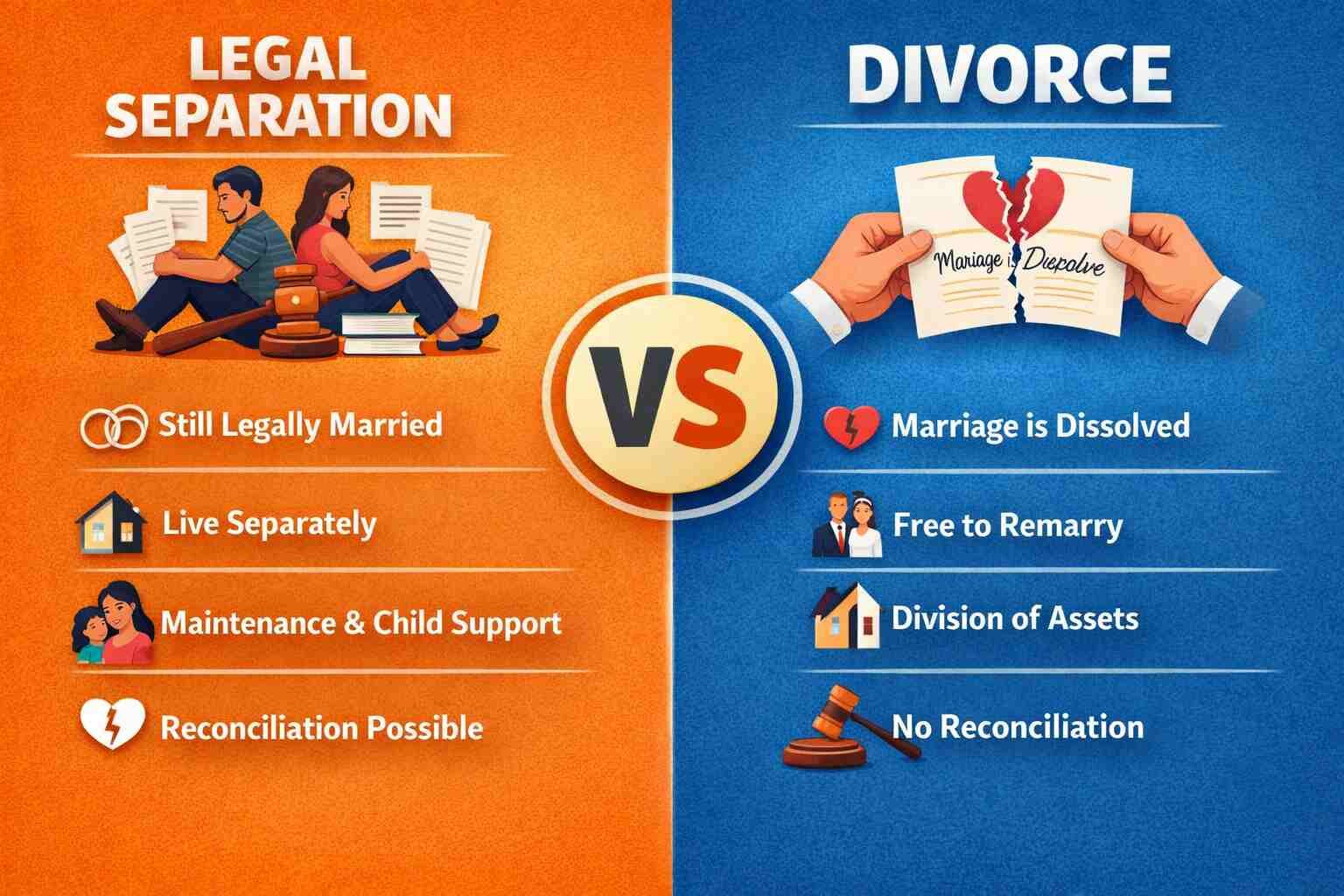
Legal Separation vs Divorce: The Core Differences
Let us compare legal separation vs divorce in a clear and practical way.
1. Marital Status
Judicial Separation:
You stay legally married.
Divorce:
The marriage ends completely.
This single difference often decides which option couples choose.
2. Right to Remarry
Judicial Separation:
You cannot remarry because the marriage still exists.
Divorce:
You can remarry after the court grants the decree.
Courts treat this rule strictly. They do not allow shortcuts.
3. Reconciliation Possibility
Judicial Separation:
Couples can reconcile easily without filing a new marriage registration.
Divorce:
If partners reconcile, they must remarry legally.
Many couples choose Judicial separation in India because they want time to heal before making a final decision.
4. Financial and Property Rights
Both options allow courts to decide:
- Maintenance or alimony
- Child custody
- Property distribution
However, divorce creates permanent financial separation, while judicial separation leaves room for future adjustment.
A reliable matrimonial lawyer in Saket Court can evaluate your financial situation and recommend the right path.
Benefits of Staying Married but Separated
Some couples do not want to end their marriage immediately. They prefer distance, reflection, and stability. This situation highlights the benefits of staying married but separated.
Key Advantages
1. Time to Think Clearly
Emotions run high during marital conflict. Separation gives breathing space. Decisions become calmer and more rational.
2. Protection of Social or Religious Beliefs
In many Indian families, divorce carries social pressure. Judicial separation respects cultural values while protecting legal rights.
3. Financial Security
Spouses may continue receiving maintenance or shared benefits during separation.
4. Easier Reconciliation
Couples can go back to being married without any legal problems if their relationship gets better.
Family courts try to bring families back together whenever they can. The Family Courts Act of 1984 says that judges often suggest mediation before giving a divorce.
Yes, the law does believe in giving people a second chance. It is surprisingly positive.
When Should You Choose Judicial Separation?
Judicial separation works best in specific situations.
Consider This Option If:
- You want temporary distance from your spouse
- You are unsure about divorce
- You need time to resolve financial or child custody issues
- Your religion or family discourages divorce
A Family court separation order can provide structure and protection during this transition period.
If you want professional guidance, you can locate experienced legal assistance through the Google My Business profile of Global Judex Law Firm, which helps clients understand separation and divorce procedures in a clear and lawful manner.
When Is Divorce the Better Choice?
Sometimes, reconciliation becomes impossible. In such cases, divorce offers closure and stability.
Divorce May Be Suitable If:
- The relationship involves abuse or cruelty
- One spouse has abandoned the marriage
- Trust has completely broken down
- Both partners agree to end the marriage permanently
Courts aim to protect dignity and safety. They do not force couples to stay in harmful relationships.
A trusted divorce lawyer in Saket Court can handle paperwork, represent your interests, and ensure compliance with legal procedures.
Legal Process for Judicial Separation in India
The process follows a structured path.
Step-by-Step Overview
- Make a request in family court
- Provide proof that the grounds for separation are true.
- Go to counseling or mediation sessions.
- Make your case in front of the judge
- Get the court order to separate
This process usually takes less time than divorce because it does not dissolve the marriage.
Working with a knowledgeable matrimonial lawyer in Saket Court can speed up documentation and reduce procedural errors.
Legal Process for Divorce in India
Divorce involves similar steps but includes additional legal scrutiny.
Basic Divorce Procedure
- Send in a divorce petition
- Give supporting documents
- Take part in mediation
- Go to court hearings
- Get the final divorce papers
Mutual consent divorce often moves faster than contested divorce. Courts typically require a cooling-off period to encourage reconciliation, though they may waive it in certain circumstances based on Supreme Court judgments.
Common Myths About Legal Separation Vs Divorce
Let us clear up a few misconceptions.
Myth 1: Judicial Separation Automatically Leads to Divorce
False. Many couples reconcile after separation.
Myth 2: Divorce Always Takes Years
Not always. Mutual consent cases can finish much faster.
Myth 3: Separation Means No Financial Support
Incorrect. Courts can order maintenance during separation.
Legal clarity prevents costly mistakes. A proactive approach saves stress later.
Final Thoughts: Choosing the Right Path for Your Future
You can make better choices through your knowledge of legal separation vs divorce. The two options exist for distinct purposes. The first option gives people time to think about their choices. The second option delivers finality while giving people their own space.
Your personal objectives together with your safety needs and your family circumstances will determine which option you should choose.
The correct legal procedures and your rights protection will be established through consultation with a certified matrimonial attorney at Saket Court. Legal assistance transforms confusing situations into confident understanding.
The legal system provides straightforward solutions to the complex nature of marriage. And sometimes, clarity is the strongest form of peace.